




Key Highlights
- Osgood-Schlatter disease in adults can continue from the teenage years
- Pain usually sits at the front of the knee, just below the kneecap
- A bony bump and tibial tuberosity pain are common findings
- Symptoms worsen with activity, kneeling, or pressure
- Diagnosis relies on clinical exam and imaging
- Osgood-Schlatter treatment focuses on reducing strain and improving strength
Some knee issues do not begin in adulthood. They start much earlier and stay quiet for years. Then one day, without a clear injury, the same spot below the kneecap begins to hurt again.
You may press that area and feel a small bump. It feels familiar, almost like something left behind from the past. This is often how Osgood-Schlatter disease in adults shows up. It is not new. It is something that has never fully settled.
What Is Osgood-Schlatter Disease?
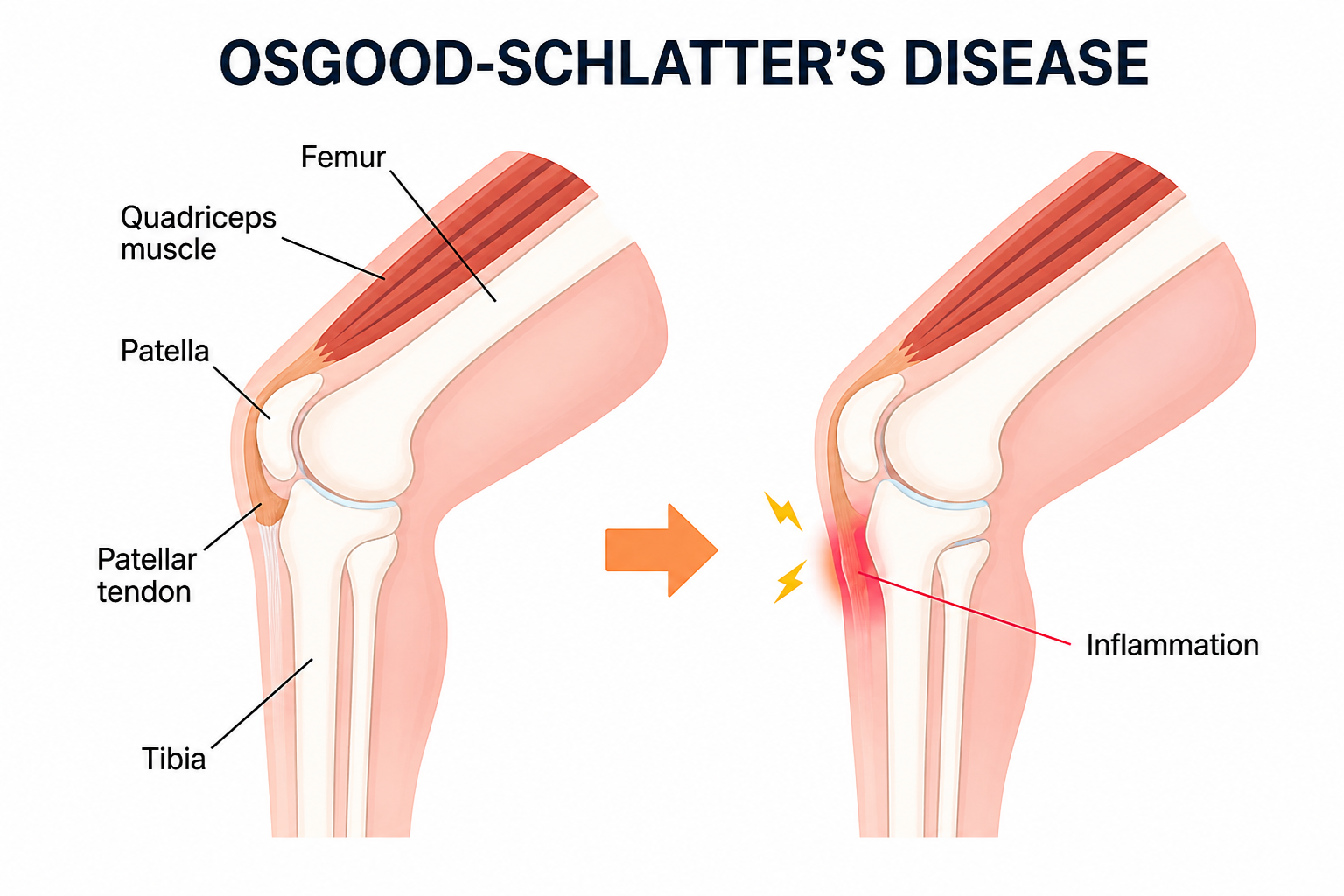
Osgood-Schlatter disease is a condition that affects the area just below the kneecap where the tendon attaches to the shin bone. During growth years, repeated stress can pull on this point. Over time, the body reacts by forming a small bump. In many cases, the pain settles after adolescence, but the bump may remain. In adults, the issue is usually not new damage but a leftover change that becomes painful again under stress.
Anatomy: Understanding the Tibial Tuberosity
To understand this condition, it helps to look at tibial tuberosity anatomy. This is the raised area on the front of the shin bone, just below the knee. The patellar tendon connects here and transfers force from the thigh muscles to the lower leg. Every time you straighten your knee, this point takes load. If that load becomes excessive, the area becomes irritated.
Symptoms of Osgood-Schlatter Disease in Adults
The OSD symptoms in adults are usually local and easy to pinpoint.
Prominent Bony Bump Below the Kneecap
A visible bump below the kneecap is common and becomes noticeable when touched.
Pain with Activity and Pressure
Pain increases during movement such as climbing stairs, squatting, or running.
Tenderness at the Tibial Tuberosity
Pressing the area often causes discomfort where the tendon attaches.
Pain After Sitting for Long Periods
The knee may feel stiff when standing after long sitting.
Swelling and Inflammation During Flares
Mild swelling and warmth may appear during active phases.
Causes and Triggers in Adults
The Osgood-Schlatter causes are linked to stress on an already sensitive area.
Residual Ossicle from Adolescence
A small bone fragment may remain and cause irritation under load.
Return to Sports or High-Impact Activity
Sudden return to activity can trigger symptoms.
Quadriceps Tightness and Weakness
Tight or weak thigh muscles increase stress on the tendon.
Occupations Requiring Kneeling
Frequent kneeling can worsen symptoms over time.
Rapid Increase in Training Load
Sudden activity increases can lead to irritation.
Diagnosing OSD in Adults
Osgood-Schlatter diagnosis is usually straightforward.
Physical Examination
The doctor checks tenderness, swelling, and movement.
X-Ray (Shows Ossicle)
X-rays may reveal bone fragments or structural changes.
Ultrasound Assessment
Ultrasound helps assess tendon irritation and inflammation.
Treatment Options for Adult OSD
Osgood-Schlatter treatment focuses on reducing stress on the area.
- Activity modification
- Stretching for flexibility
- Strengthening exercises
- Support straps
- Pain management methods
Surgery is rarely required and only considered in severe persistent cases.
Prevention Strategies
- Warm up before activity
- Increase activity gradually
- Maintain muscle flexibility
- Avoid prolonged pressure on the knee
- Use proper exercise technique
Why Choose Alleviate Pain Clinic for OSD?
Care focuses on movement patterns, muscle balance, and reducing stress on the joint to prevent recurring pain.


