

Menu

Spondylolisthesis: Types, Symptoms, Complications, Diagnosis & Treatment

Back pain can range from a mild nuisance to a serious problem that interferes with everyday life. While many people assume their discomfort is simply due to a muscle strain, the root cause can sometimes lie deeper in the spine. One condition that often contributes to persistent back pain is spondylolisthesis.

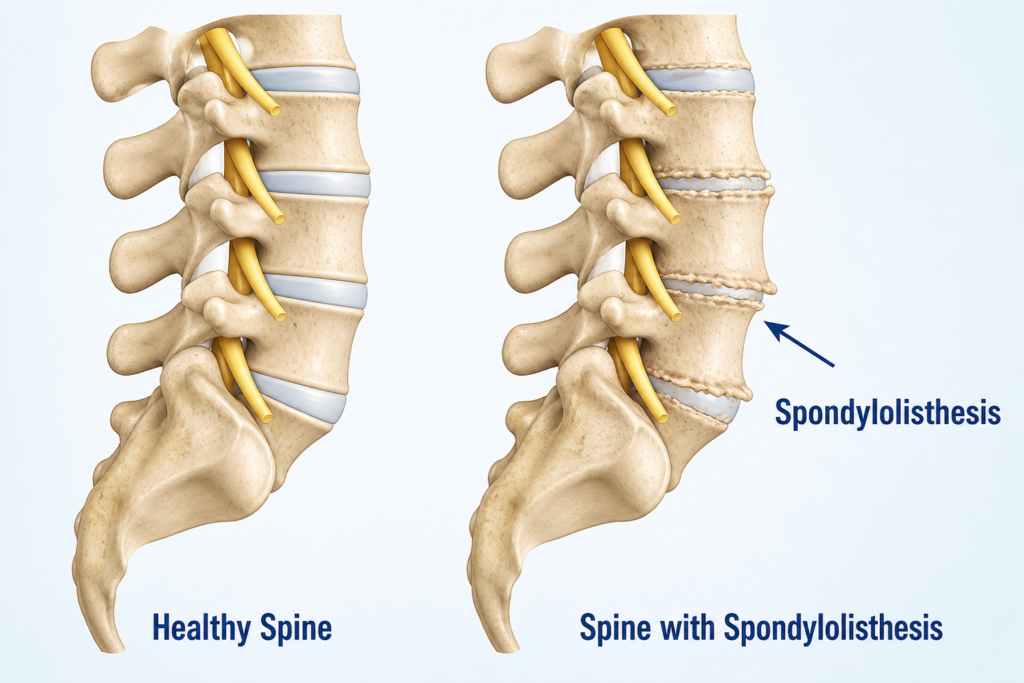
This condition occurs when one vertebra slips out of its normal position and moves over the vertebra beneath it. The shift can place pressure on nearby nerves, leading to pain, stiffness, and mobility problems. Recognizing spondylolisthesis symptoms early and seeking timely spondylolisthesis treatment can make a significant difference in long-term outcomes.

What Is Spondylolisthesis?

The spondylolisthesis definition refers to the forward, backward, or sideways displacement of one vertebra over the one below it. Although the term sounds complex, the concept is simple: the normal alignment of the spinal bones is disrupted.

Think of the spine as a neatly stacked column of blocks. When one block shifts out of place, the stability of the entire structure can be affected. Spondylolisthesis most commonly develops in the lumbar (lower) spine, though it can occasionally occur in the cervical or thoracic regions.

Understanding Spinal Anatomy

To understand Spondylolisthesis Anatomy, it helps to know how the spine is structured. The human spine contains 33 vertebrae stacked vertically and connected by joints, ligaments, and cushioning discs. These components allow flexibility while maintaining stability.

A key structure involved in many cases is the pars interarticularis, a small bridge of bone connecting the rear joints of each vertebra. When this area weakens or develops a stress fracture, it can allow the vertebra to slip forward, resulting in spondylolisthesis.

How Common Is Spondylolisthesis?

The spondylolisthesis prevalence varies across populations. Studies suggest that roughly 3.1% of adults have some degree of vertebral slippage. The related condition, spondylolysis (a pars stress fracture), is slightly more common, affecting about 3–8% of adults.

Importantly, many people with mild spondylolisthesis have no symptoms and discover it only when imaging is done for another reason.

Types of Spondylolisthesis

There are several recognized types of spondylolisthesis, each classified based on the underlying cause.

1. Isthmic Spondylolisthesis

Isthmic Spondylolisthesis frequently affects children and adolescents. It develops when a stress fracture in the pars interarticularis allows the vertebra to slip forward. Repetitive spinal extension, common in sports, is a major contributing factor.

2. Degenerative Spondylolisthesis

Degenerative Spondylolisthesis is the most common form seen in adults over 50. With aging, spinal discs lose height and ligaments become lax, creating instability that allows vertebral slippage. This type occurs significantly more often in women.

3. Congenital Spondylolisthesis

Congenital Spondylolisthesis (also called dysplastic) occurs when a person is born with structural spinal abnormalities that predispose the vertebrae to misalignment later in life.

4. Traumatic Spondylolisthesis

Traumatic Spondylolisthesis results from acute, high-impact injuries such as motor vehicle accidents or severe falls that fracture parts of the vertebra.

5. Pathological Spondylolisthesis

This form develops when underlying conditions, such as tumors, infections, or osteoporosis, weaken the vertebral bones and make them vulnerable to slipping.

6. Post-Surgical (Iatrogenic) Spondylolisthesis

In some cases, prior spinal surgery (especially extensive decompression procedures) can lead to instability and subsequent vertebral slippage.

Spondylolisthesis Grading System

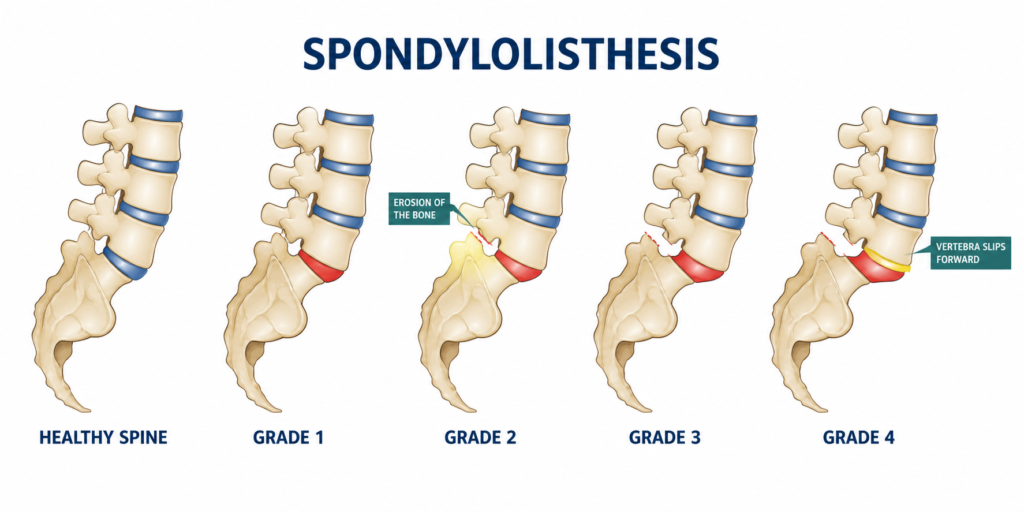
Clinicians use Spondylolisthesis Grading (Meyerding classification) to measure how far the vertebra has slipped.

Grade I (1–25% Slippage)

Grade 1 spondylolisthesis involves mild displacement. Most patients at this stage respond well to conservative care.

Grade II (26–50% Slippage)

In grade 2 spondylolisthesis, the vertebra has shifted between 26% and 50%. Many degenerative cases fall into this category.

Grade III (51–75% Slippage)

Grade 3 spondylolisthesis is considered high grade and carries a greater likelihood of nerve involvement.

Grade IV (76–100% Slippage)

Grade IV indicates severe displacement. Complete slippage beyond this point is termed spondyloptosis.
Spondylolisthesis Symptoms & Signs

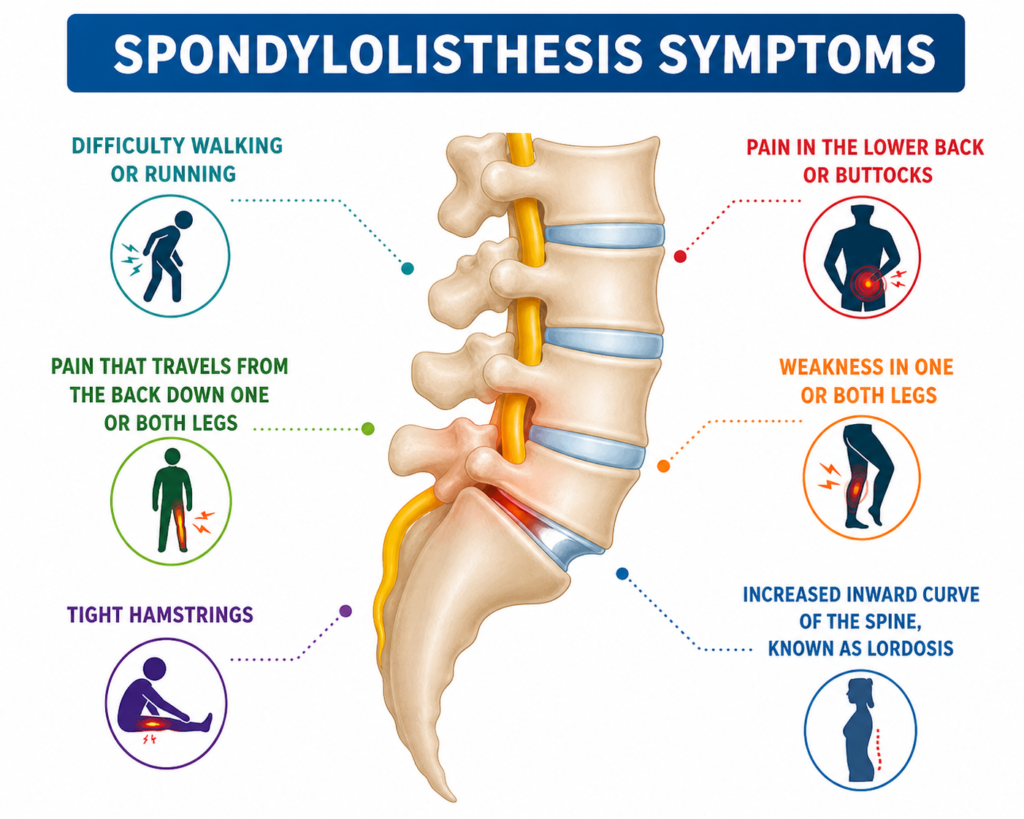
The intensity of spondylolisthesis symptoms varies widely. Some individuals have no complaints, while others experience significant discomfort.

Common Symptoms of Spondylolisthesis

Typical symptoms include:

  • Persistent lower back pain
  • Back stiffness
  • Tight hamstrings
  • Forward-leaning posture
  • Pain radiating into the buttocks or thighs

Neurological Symptoms

If nerve compression occurs, patients may notice:

  • Sciatica (shooting leg pain)
  • Numbness or tingling in the legs
  • Muscle weakness
  • Difficulty walking or standing for long periods

When Are Symptoms Worse?

Pain often worsens during activities involving spinal extension, such as prolonged standing or walking. Many patients report relief when bending forward or sitting.

Symptoms in Children vs. Adults

In pediatric spondylolisthesis, symptoms often emerge during growth spurts (ages 10–15) and may include an altered walking pattern. Adults are more likely to experience symptoms related to spinal stenosis and age-related degeneration.
What Causes Spondylolisthesis?

Common spondylolisthesis causes include:

  • Age-related disc degeneration
  • Pars interarticularis stress fractures
  • Congenital spinal defects
  • Traumatic injuries
  • Bone-weakening disorders

Risk Factors You Should Know

Risk increases in individuals who are:
  • Female (for degenerative type)
  • Over age 50
  • Genetically predisposed
  • Exposed to repetitive spinal stress

Sports & Activities That Increase Risk

Higher-risk activities include gymnastics, football, wrestling, and diving due to repeated spinal hyperextension.

Complications of Untreated Spondylolisthesis

Possible spondylolisthesis complications include:

  • Chronic back pain
  • Progressive spinal arthritis
  • Persistent nerve compression
  • Loss of bowel or bladder control (medical emergency)

Early intervention greatly reduces these risks.

How Is Spondylolisthesis Diagnosed?

A proper spondylolisthesis diagnosis combines clinical evaluation with imaging.

Medical History & Physical Examination

Your physician will review symptoms and check for:

  • Palpable step-off in the spine
  • Reduced range of motion
  • Neurological deficits in the legs

Imaging Tests

Common tests include:

  • Standing X-rays (first line)
  • MRI (to evaluate nerves and discs)
  • CT scan (detailed bone assessment)

Spondylolisthesis Treatment Options

The primary goal of spondylolisthesis treatment is to relieve pain, stabilize the spine, and restore function. Most patients improve without surgery.

Non-Surgical (Conservative) Treatments

Initial management typically includes:

  • Activity modification
  • Physical therapy
  • Core strengthening and exercises for spondylolisthesis
  • Anti-inflammatory medications
  • Targeted spinal injections when needed

Regenerative Medicine Treatments at Alleviate Pain Clinic

Alleviate Pain Clinic specializes in advanced, non-surgical care. Their regenerative options include:

  • Platelet-Rich Plasma (PRP) therapy
  • Prolotherapy
  • Stem cell therapy
  • Ultrasound-guided precision injections

These therapies support natural healing, strengthen stabilizing structures, and provide effective spondylolisthesis treatment without major surgery.

When Is Surgery Needed?

Surgery is generally considered only when:

  • Slippage is high grade
  • Significant neurological deficits are present
  • Conservative care fails after several months

Spinal fusion remains the most common surgical approach.

Can Spondylolisthesis Be Prevented?

While not entirely preventable, risk may be reduced by:

  • Maintaining strong core muscles
  • Using proper athletic technique
  • Supporting bone health
  • Avoiding repetitive hyperextension injuries

Why Choose Alleviate Pain Clinic for Spondylolisthesis Treatment in Bangalore?

Alleviate Pain Clinic is recognized for its expertise in treating spondylolisthesis using minimally invasive, evidence-based methods. The multidisciplinary team, including Dr. Swagatesh Bastia and Dr. Wiquar Ahmed, focuses on personalized care tailored to each patient’s spondylolisthesis symptoms.

FAQ's About Spondylolisthesis

What is spondylolisthesis and how serious is it?

Spondylolisthesis is the slippage of a spinal vertebra. Severity ranges from mild and manageable to serious cases involving nerve compression.

What are the early warning signs of spondylolisthesis?

Early spondylolisthesis symptoms commonly include ongoing lower back pain, stiffness, and hamstring tightness.

Can spondylolisthesis heal on its own?

The slippage itself typically does not reverse, but symptoms often improve with proper spondylolisthesis treatment.

What is the difference between isthmic and degenerative spondylolisthesis?

Isthmic Spondylolisthesis stems from a pars fracture (usually in younger patients), while Degenerative Spondylolisthesis results from age-related spinal wear.

Do I need surgery for spondylolisthesis?

Most patients do not require surgery. It is reserved for severe cases when conservative spondylolisthesis treatment fails.

What are the best exercises for spondylolisthesis?

Core stabilization, pelvic tilts, hamstring stretches, and low-impact aerobic activities are among the most effective exercises for spondylolisthesis when guided by a qualified physical therapist.

Video Spotlight

youtube tmbnal
Blog

Surgery-Free Solutions

Expert Tips for Pain Management

Exercise for back pain
10 Exercises to Ease Back Pain and Regain Comfort
Dr. Swagatesh Bastia MBBS, M S (Ortho), Fellow in Trauma and Orthopaedics (UK), Fellow in Pain Management. Doing back...
Read More
Is Back Pain Caused by Kidney Stones
Is Back Pain Caused by Kidney Stones? Signs and Solutions
Dr. Swagatesh Bastia MBBS, M S (Ortho), Fellow in Trauma and Orthopaedics (UK), Fellow in Pain Management. Pain...
Read More
blog Sharp
Sudden Sharp Lower Back Pain When Bending: Causes & Treatments
A sudden, sharp pain in the lower back when bending over is an alarming experience that can leave you...
Read More

Testimonials

Words From Our Patients

I’ve had my pain management treatment for low back sciatic pain from Alleviate Jayanagar, I’m recovering well and coming out of pain. Thanks to Dr. Wiquar Ahmed for taking necessary steps and making us understand the underlying issues and also for being helpful and supportive. I also thank Dr. Rijo for helping in physiotherapy. Thanks to Swarna for being very reachable and co-operative throughout.

Sindhu S

GOPALAKRISHNA from Nelamangala suffering from low back pain. Visited alleviate pain management hospital in dasarahalli .consulted dr wiqqar Ahmed and he explained the problem of lower back pain and suggested for physiotherapy and now I am feeling better

Gopala Krishna

consulted for my Aunty Sumitra with Dr Swagatesh in Alleviate Dasarahalli clinic for sever low back pain doctor explained procedure and done ..After that with Dr.chaithra she took physiotherapy after her treatment she very happy and she is very good now..Thank u Alleviate

Hr7 master S

Dr wiquar ahmed treated me, he dioganised my left theigh and leg pain, he was advising politely and friendly atmosphere, Injucted effected lower spinal disc very carefully. I wish for his most success in career and devolopment of all alliviate pain management hospital to treat all pain persons. Physiotheraphy sect io n and reception sections are having good staff. all are very polite and good behaviour persons. Once again i an all staff. Thanks to all.

Puttaiah Basavarajappa


Wait! Don’t
Leave in Pain!

We’re just call away from helping you live pain-free.
Call now for a consultation 080-25256878

Call Us Now

Limited Slots Available Today